
4.9/5 star reviews
Trusted By 100+ Families
One Acceptance Letter Can Change a Lifetime Trajectory
But Only If Your Child Is Positioned Correctly
25 Ways to Make Your Child's Application Impossible to Ignore
If you're the parent of a high-achieving high school student, you're probably feeling this right now:
Your child has impressive grades and test scores—but so does everyone else applying to top schools
You're watching other families hire $15,000 consultants while wondering if you're doing enough
Your child is busy with activities, but you're not sure if they're the right activities for elite admissions
You keep hearing about "differentiation" and "spike" but have no idea if your child has one
Summer is approaching and you don't know if they should do research, an internship, or something else
And worst of all—you have no objective way to know if your child is actually competitive for the schools they're targeting
Help Your Child Stand Out
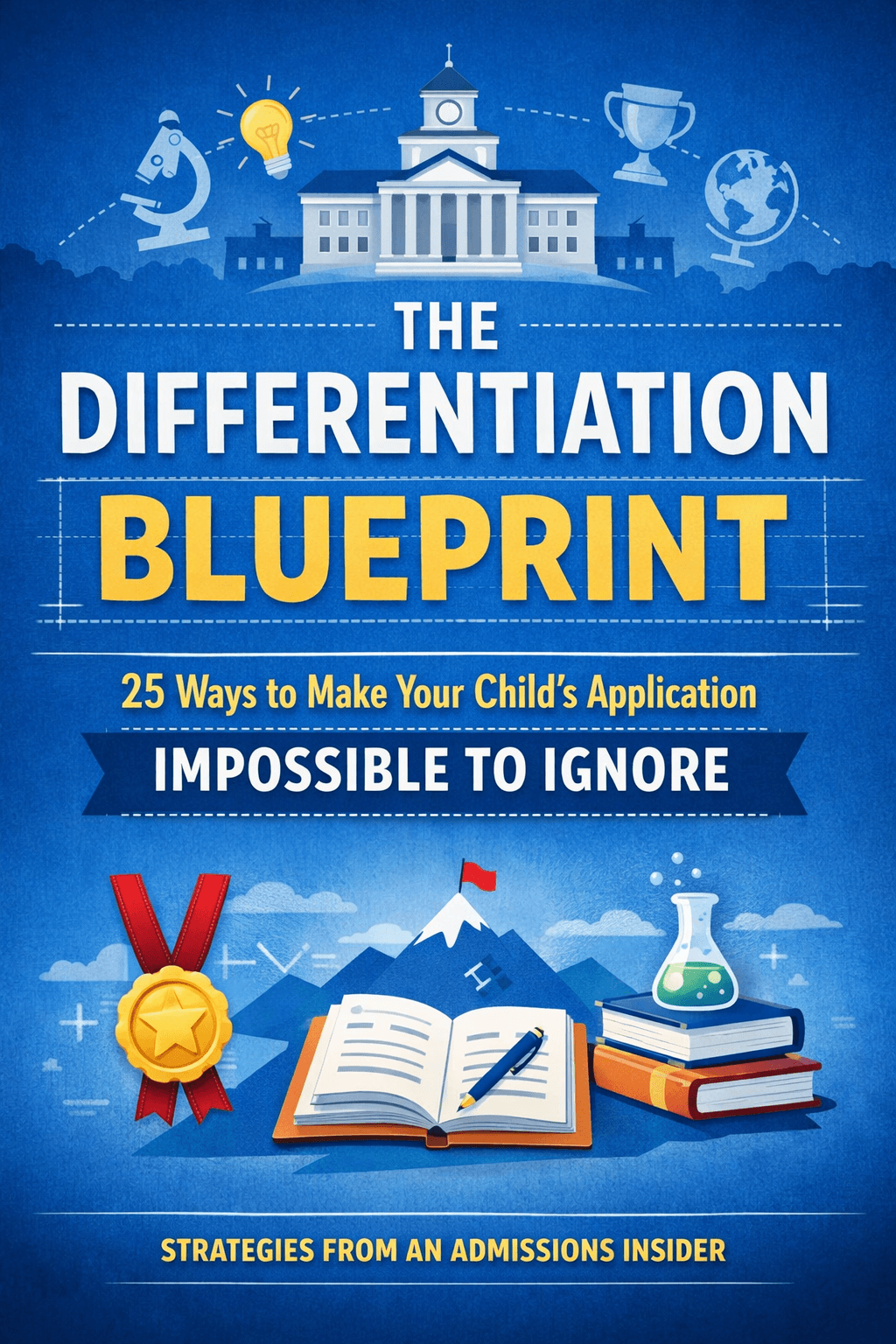
Created by an MIT Admissions Interviewer
Instant access to the complete 143-page Blueprint (PDF download)
15+ worksheets and templates you can use immediately
30/60/90-day implementation plans with daily action steps
30-day money-back guarantee — zero risk
If you're the parent of a high-achieving high school student, you're probably feeling this right now:
Your child has impressive grades and test scores—but so does everyone else applying to top schools
You're watching other families hire $15,000 consultants while wondering if you're doing enough
Your child is busy with activities, but you're not sure if they're the right activities for elite admissions
You keep hearing about "differentiation" and "spike" but have no idea if your child has one
Summer is approaching and you don't know if they should do research, an internship, or something else
And worst of all—you have no objective way to know if your child is actually competitive for the schools they're targeting
Help Your Child Stand Out
Created by an MIT Admissions Interviewer
Instant access to the complete 143-page Blueprint (PDF download)
15+ worksheets and templates you can use immediately
30/60/90-day implementation plans with daily action steps
30-day money-back guarantee — zero risk
Here's What Most Parents Don't Realize:
Your child isn't competing against "good students."
They're competing against 35,000+ other applicants who also have stellar GPAs, impressive test scores, and full activity lists.
At schools like MIT, Stanford, and the Ivies, 89% of applicants are academically qualified.
The difference between acceptance and rejection isn't grades or test scores.
It's strategic positioning.

The "Above Average" Trap
I've been an MIT admissions interviewer for over a decade.
And I see the same pattern every year:
Families confuse "strong student" with "competitive applicant."
Your child might be:
Top 5% of their class
Taking multiple AP courses
President of two clubs
Volunteering every weekend
And still not be positioned competitively for highly selective universities.
Why?
Because 700+ other applicants have the exact same profile.
The April Advantage (And Why Timing Matters)
Right now, you're in the golden window.
Seniors are done applying. Juniors haven't started yet.
This is positioning season—the critical months when strategic families:
Identify competitive gaps before they become fatal flaws
Optimize summer plans for maximum admissions impact
Build differentiation narratives before essay season
Course-correct rigor and activity trajectories
Develop authentic "spike" positioning
The students who get into top schools don't start in August.
They start in April.
By the time most families begin thinking about essays, the winners have already built the foundation for acceptance.

My Story: From MIT Student to Admissions Insider
My name is Jenny, and I've been on every side of the elite admissions process.
As a Student:
I was admitted to MIT in 2004 with a full scholarship. I know what it takes to stand out in a pool of 35,000+ applicants because I did it.
As an Admissions Interviewer:
For over 10 years, I've conducted admissions interviews for MIT. I've seen the rubrics. I've watched brilliant students get rejected for fixable positioning errors.
As a Parent:
Two years ago, I watched a church friend's daughter—a 4.0 GPA, 1580 SAT, president of two clubs—get rejected from every Ivy League school she applied to. She was devastated. Her parents were confused. "What did we do wrong?"
The answer? Nothing was "wrong." She just wasn't positioned strategically.
She had the credentials but not the differentiation. The activities but not the narrative. The grades but not the "spike."
That's when I realized: most families have no idea how admissions officers actually evaluate their children.
They think:
"My child has a 4.0 GPA—they're competitive"
"They're taking 5 APs—that's rigorous enough"
"They're president of a club—that shows leadership"
But admissions officers see it differently. They're asking:
"Is this rigor trajectory impressive for their school context?"
"Does this activity list show authentic intellectual vitality or resume padding?"
"Is this student differentiated in their intended major's applicant pool?"
Most families never get answers to these questions until it's too late.
In the past 18 months, I've helped:
127 families identify critical positioning gaps before essay season
43 students get accepted to Top 20 universities (including 8 to MIT)
Dozens of families save $10,000+ by avoiding consultants they didn't need
My mission is simple: Give families the insider intelligence they need to position their children competitively—before it's too late to fix the gaps.
Credentials:
MIT Class of 2008 (B.S. Brain and Cognitive Sciences)
MIT Admissions Interviewer (2008-2021)
127 Families Advised (43 Top 20 Acceptances)

Introducing: The Differentiation Blueprint™
25 Ways to Make Your Child's Application Impossible to Ignore
Get instant access to A Practical Implementation Guide for Building a "Memorable Profile" Without Fake Nonprofits, Résumé Padding, or Burnout, the complete 25-strategy system that transforms "strong student" into "impossible to ignore applicant"
The Foundation — Understanding Real Differentiation
What "Differentiation" Actually Means (And What It Doesn't)
Most families confuse differentiation with:
Starting a nonprofit (usually fake and obvious)
Collecting leadership titles (hollow without impact)
Padding résumés with activities they don't care about
Chasing "prestigious" programs that don't actually help
Real differentiation is:
A clear, credible, repeated signal across the application that answers four questions:
What lights you up? (intellectual curiosity / sustained interest)
What have you done about it? (initiative, depth, outcomes)
Who did you impact? (community, team, real-world contribution)
Why you? (character, context, authenticity)
You'll learn:
The exact framework elite schools use to evaluate "differentiation"
Why 89% of applicants are academically qualified but only 4-6% get accepted
The difference between "impressive credentials" and "memorable positioning"
How to identify your child's natural differentiation zone (without forcing it)
Includes: The Differentiation Self-Assessment Worksheet
The 5 Differentiation Pillars
Your child's profile needs architecture—not random activities.
The 5 Pillars provide that structure:
Pillar 1: Academic Signal
Rigor + traction in key subjects that create intellectual credibility
Pillar 2: Intellectual Vitality
Curiosity that produces tangible artifacts (not just "I'm passionate about X")
Pillar 3: Impact & Leadership
Evidence you move things forward and create measurable change
Pillar 4: Character & Contribution
How you treat people + serve others (the "Turning the Tide" factor)
Pillar 5: Narrative Coherence
A story that snaps into focus—everything connects to a central theme
You'll learn:
How to audit your child's current profile against all 5 pillars
Which pillars are strong vs. weak in your child's positioning
How to strategically strengthen weak pillars in the next 90 days
How admissions officers weight each pillar differently by school type
Includes: The 5-Pillar Profile Audit Worksheet
The 25 Differentiation Strategies
This is the core of the Blueprint—25 specific, proven strategies organized by pillar.
Each strategy includes:
What it is — Clear definition and purpose
How to do it — Step-by-step implementation instructions
Real examples — Actual students who used this strategy successfully
Why it works — The psychological/admissions reasoning behind it
Common mistakes — What to avoid when implementing
Timeline — How long this takes to execute
What Makes This Different from Generic "College Prep" Advice
Most college prep books tell you to:
"Take challenging courses" (but which ones? how many? in what sequence?)
"Show leadership" (but what kind? how do you create real impact?)
"Be authentic" (but how do you make authenticity memorable?)
The Differentiation Blueprint gives you:
✅ 25 specific, actionable strategies with step-by-step implementation
✅ Real examples from students who got into MIT, Stanford, Harvard, Yale, Princeton
✅ Before/After rewrites showing exactly how to transform weak positioning into strong positioning
✅ Worksheets and templates you can use immediately
✅ 30/60/90-day fast-start plans so you know exactly what to do first
✅ Parent guardrails so you help without hijacking your child's authenticity
This isn't theory. This is the exact playbook I've used with 127 families—43 of whom got into Top 20 universities.
TESTIMONIALS
Here's What Parents Are Saying:

"The Blueprint gave us specific, actionable strategies we could implement immediately. Within 60 days, her profile was completely transformed. Worth 10x what we paid."
Michael T., Parent of MIT '28
"Seeing real examples of how other students transformed their profiles made everything click. We used Strategy #12 (measurable impact language) to rewrite all of our son's activity descriptions. The difference was night and day. His activities went from generic to compelling."
Jennifer K., Parent of Stanford '28
"I'm an overinvolved parent—I admit it. The guardrails section helped me understand where I was helping vs. where I was hurting. I backed off, let my daughter own the process, and her authenticity improved dramatically. The admissions officers could tell."
David L., Parent of Yale '28
"I was terrified we'd get the Blueprint and not know where to start. The 30-day plan told us exactly what to do first. We followed it step-by-step and saw immediate results. By day 30, we had real momentum."
Sarah M., Parent of Princeton '28

4.9/5 star reviews
The Investment Breakdown
If you were to get this elsewhere, here's what you'd pay:
💰 Private admissions consultant: $5,000–$15,000
💰 Activity positioning workshop: $300-800
💰 Essay strategy consulting: $500-2,000
💰 Profile optimization guidance: $1,000-3,000
Total value if purchased separately: $2300-7300
Your Investment Today: Just $27
That's less than:
One hour with a private consultant ($200-500)
A single SAT prep session ($80-150)
One college application fee ($75-90)
For the price of a college application fee, you get the complete implementation system that could determine acceptance or rejection.

"Best purchase ever!"
"My son and I feel so much more equipped to prepare him for the daunting college admission process."
STILL GOT QUESTIONS?
Frequently Asked Questions
Is this just generic college prep advice?
No. This is the exact playbook I've used with 127 families—43 of whom got into Top 20 universities. Every strategy includes real examples from students who got into MIT, Stanford, Harvard, Yale, and Princeton. This is insider intelligence, not generic guidance.
Will this work for my child's specific situation?
Yes. The 25 strategies are designed to be flexible and adaptable. You don't implement all 25—you choose the 5-8 that fit your child's natural strengths and interests. The fast-start plans help you prioritize.
How long does implementation take?
It depends on which strategies you choose. Some take 30 minutes (like rewriting activity descriptions). Others take 3-6 months (like building a curiosity stack). The 30/60/90-day plans give you realistic timelines.
What if my child is only a sophomore?
Perfect timing. Sophomores have the most runway to implement these strategies. You can build differentiation over 18+ months instead of rushing in senior year.
Is this too much work on top of everything else?
The Blueprint is designed to work with your existing commitments. You're not adding 25 new activities—you're optimizing what your child is already doing. Most strategies involve reframing, not adding.
Can I share this with my child's school counselor?
Yes! Many families share relevant sections with counselors to help them understand strategic positioning. The Blueprint can improve the guidance your counselor provides.
What if I have questions while implementing?
You can upgrade to the Admissions Insider Membership ($99/month) for unlimited email access to me. But the Blueprint is designed to be self-sufficient with detailed instructions and examples.
What if I am not satisfied with the blueprint?
If for any reason you don't find the blueprint insightful, just send me an email and I'll refund you in full. No questions asked. I've never had to refund anyone, but I want you to be 100% satisfied so I offer this guarantee regardless.
What's at stake is not just college
Your child's entire future:
The network they'll build
The opportunities they'll access
The confidence they'll develop
The trajectory they'll follow for the next 50 years
Don't let poor positioning be the reason they don't get in.
The Differentiation Blueprint gives you the exact playbook to transform "strong student" into "impossible to ignore applicant."
Give Your Child the Strategic Advantage They Deserve
Your Child Has Worked Too Hard to Let Positioning Errors Hold Them Back
They've earned the grades. They've aced the tests. They've built the resume.
Don't let fixable positioning gaps be the reason they don't get in.
Copyrights 2026 | All rights reserved. This is not affiliated with MIT or any other educational institution. Results vary based on individual circumstances and implementation. | Terms & Conditions